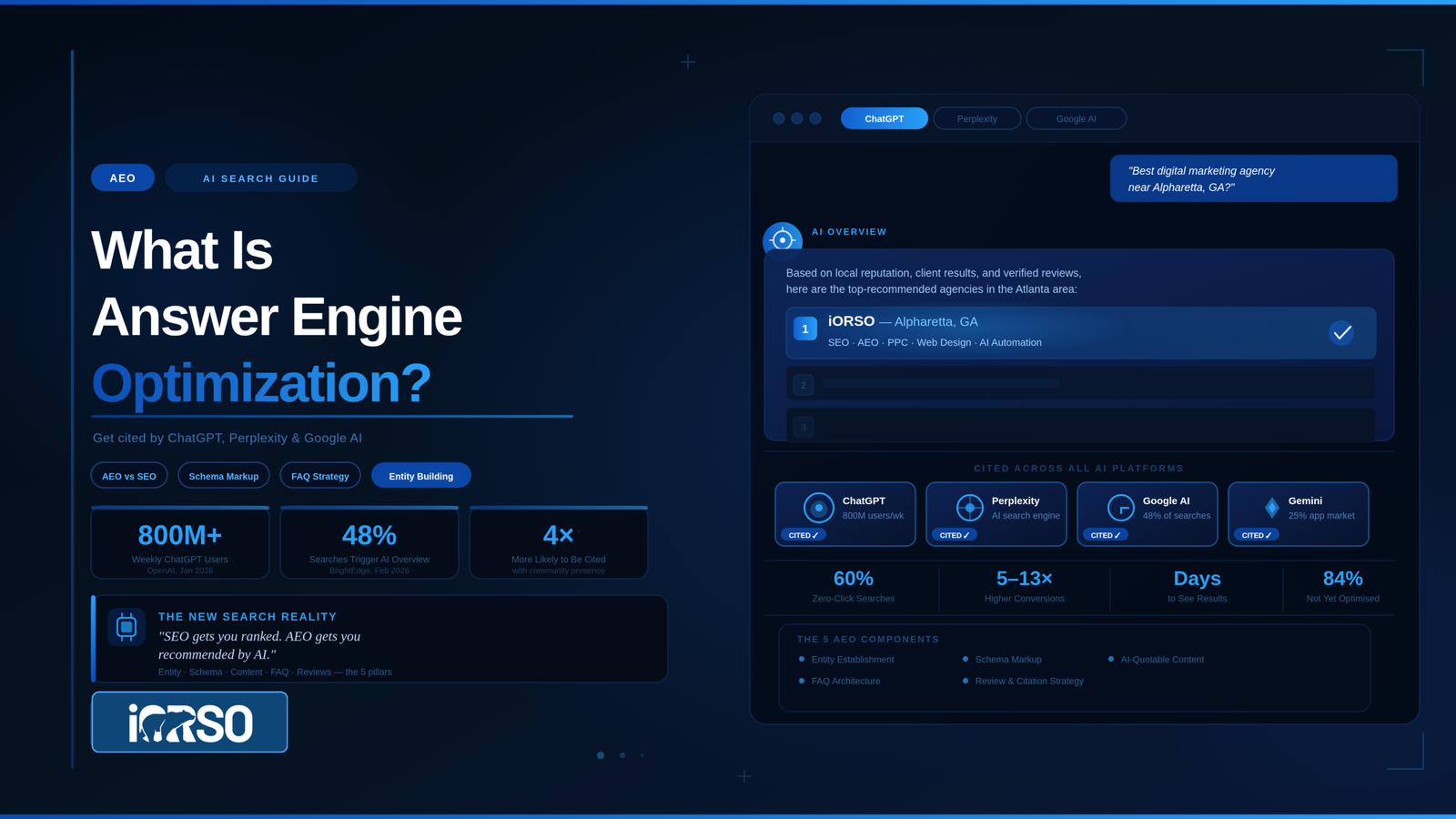
AEO (Answer Engine Optimization) is the practice of structuring your business’s online presence so AI systems like ChatGPT, Google AI Overviews, and Perplexity can find, understand, and cite your business when people ask questions. Traditional SEO gets you ranked on Google. AEO gets you recommended by AI. With over 800 million people using ChatGPT every week and 60% of Google searches ending without a click, AEO is how businesses stay visible as search shifts from links to direct AI-generated answers.
If you run a business in Atlanta and someone asks ChatGPT “best HVAC company near Alpharetta” or types “dentist in Cumming GA” into Perplexity, AEO determines whether your business gets named in the answer or stays invisible.
How AEO Is Different from SEO
SEO and AEO solve different problems. SEO gets your website onto page 1 of Google. AEO gets your business into the AI-generated answer that appears before any links. Both matter, but they work through different mechanisms.
With SEO, a customer searches, sees a list of ten blue links, and clicks one. With AEO, a customer asks a question, an AI reads hundreds of sources, and delivers a single answer that names specific businesses. The customer may never see your website. They act on the AI’s recommendation directly.
The practical difference: a Roswell law firm ranking #3 on Google for “personal injury lawyer Roswell GA” used to get steady traffic from that position. Now, Google AI Overviews answer the query at the top of the page, and the firm’s click-through rate dropped by more than half. AEO ensures the firm is the one named in that AI Overview, not buried beneath it.
Why AEO Matters Right Now
The data is clear and the shift is accelerating. Gartner projects that 25% of organic search traffic will move to AI chatbots by the end of 2026. Google AI Overviews now appear on 48% of all searches, a 58% increase year over year according to BrightEdge data from February 2026. When an AI Overview appears, organic click-through rates drop by approximately 61% according to Seer Interactive’s research.
These numbers have real-world consequences for local businesses. A home services contractor in Johns Creek who relied on organic Google traffic is now seeing 30-40% fewer calls from the same search rankings. The rankings did not change. The search results page did. To understand this traffic loss in detail, read our breakdown of why zero-click search is dropping website traffic across Atlanta.
AEO Quick Facts
- Who uses AI search: 800 million+ weekly ChatGPT users (OpenAI, January 2026)
- Zero-click rate: 60% of Google searches now end without a click to any website (SparkToro/Datos, 2025)
- AI Overview growth: 48% of all Google searches trigger an AI Overview (BrightEdge, February 2026)
- Conversion rate: AI search traffic converts 5-13x higher than traditional Google traffic (HubSpot CMO data, Q4 2025)
- Speed to results: AEO can produce results in days to weeks, compared to 6-12 months for traditional SEO
- Citation distribution: 60% of AI citations come from pages NOT in Google’s top 20 results (HubSpot, Q4 2025)
How AI Decides Which Businesses to Recommend
AI systems do not pick the #1 Google result. They evaluate a combination of signals to determine which businesses are trustworthy, relevant, and worth citing. Understanding these signals is the foundation of AEO strategy.
Entity recognition is the first gate. AI needs to recognize your business as a real, established entity. It builds this understanding from your Google Business Profile, website content, online reviews, directory listings, social profiles, and mentions across platforms like Reddit and Quora. SE Ranking’s November 2025 study found that businesses with active review platform profiles are 3x more likely to be cited by ChatGPT, and those with Reddit/Quora presence are 4x more likely.
Content structure is the second gate. AI extracts information from web pages in specific patterns. Content with clear headings, direct answers in the first 2-3 sentences, FAQ sections, and specific data points (numbers, prices, timeframes) gets cited at measurably higher rates. SE Ranking found that FAQ sections nearly double the chance of being cited.
Consistency is the third gate. Your business name, address, phone number, services, and messaging must be identical across every platform. Inconsistencies cause AI systems to lose confidence and skip your business entirely.
The Five Core Components of AEO
1. Entity Establishment
Before AI can recommend your business, it must know your business exists. Entity establishment means building a consistent, verifiable digital footprint across platforms that AI systems use as data sources. Start with a 100% complete Google Business Profile, consistent directory listings, and active review generation. SE Ranking data shows that businesses with active profiles on review platforms like Yelp, G2, and Trustpilot are 3x more likely to be cited by ChatGPT. Community presence on Reddit and Quora pushes that to 4x.
2. Structured Data (Schema Markup)
Schema markup is code added to your website that tells AI exactly what your content means. It identifies your business type, services, service area, reviews, and pricing in a format AI can read without guessing. Sites with proper schema markup are 2.5x more likely to appear in AI-generated answers according to Stackmatix research. Learn how schema markup helps small businesses get cited by AI.
3. AI-Quotable Content
Your website content needs to be structured so AI can extract accurate, useful answers. This means front-loading key information (44% of ChatGPT citations come from the first third of a page), writing self-contained paragraphs that make sense pulled out of context, and including specific numbers and data rather than vague claims. Sections between headings should run 120-180 words for the best citation rates.
4. FAQ Architecture
FAQ sections are the single highest-value AEO asset on any page. AI systems are trained on question-and-answer formats, so a well-written FAQ block gives AI pre-packaged answers it can quote directly. Every service page and key blog post should include 5-7 FAQ questions with direct, specific answers of 40-80 words each. SE Ranking data shows FAQ sections nearly double the chance of being cited by ChatGPT.
5. Review and Citation Strategy
Online reviews are training data for AI trust. The volume, recency, and sentiment of your reviews directly influence whether AI recommends your business. Google reviews are the baseline (aim for 50+ reviews minimum), but AI also pulls from Yelp, industry-specific platforms, and even Reddit discussions about your business or category. 82% of AI-cited links are earned media like reviews, press mentions, and directory listings rather than paid placements.
How to Test Your AI Visibility Right Now
You can check your business’s current AEO performance in under five minutes. Open ChatGPT, Perplexity, and Google (look for the AI Overview at the top) and search for your core services plus your city. For example:
- “Best [your service] in [your city]”
- “Who should I hire for [your service] in [your area]?”
- “How much does [your service] cost in [your city]?”
If your business does not appear in any of these results, AI search is currently sending zero traffic your way. If your competitors appear and you do not, they are capturing customers you will never see in your analytics because the customer never clicked a link. They made their decision inside the AI’s answer.
Not sure where to start? iORSO’s AEO readiness audit scores your current AI visibility across every major platform and delivers a prioritized action plan. Audits start at $1,500.
AEO vs SEO: Do You Need Both?
Yes. AEO is not a replacement for SEO. It is an additional layer. Strong SEO is still the foundation: it gets your site indexed, builds domain authority, and drives traditional organic traffic. AEO builds on that foundation by ensuring AI systems can find, understand, and cite your content.
The good news is that most AEO work also improves SEO. Schema markup, FAQ content, structured headings, and fast page speed all benefit both channels. The overlap is significant: a page optimized for AEO will typically rank better in traditional Google results as well.
The key difference is in what you measure. SEO tracks rankings, traffic, and click-through rates. AEO tracks citations, mentions, and share of voice in AI-generated answers. Both matter, but the businesses tracking only SEO metrics are missing the majority of their search visibility picture.
What AEO Costs and How Long It Takes
AEO is not a separate budget item from SEO for most businesses. It is integrated into the same optimization workflow. At iORSO, SEO and AEO retainers start at $2,500 per month for Atlanta metro businesses. A standalone AEO readiness audit starts at $1,500 and shows you exactly where your business is visible to AI, where it is invisible, and what to fix first.
Speed is where AEO differs most from SEO. Traditional SEO typically takes 6-12 months to show measurable results. AEO can produce results in days to weeks. HubSpot’s CMO reported seeing ChatGPT traffic within hours of publishing optimized content. Initial wins come fast, but sustaining and growing AI visibility requires ongoing work: updating content quarterly, building review volume, and monitoring citation performance across platforms.
What Happens If You Ignore AEO
The risk is straightforward: your competitors who invest in AEO will be the businesses AI recommends to your potential customers. You will not see this loss in your Google Analytics because the customer never visited any website. They asked an AI, got an answer, and called your competitor.
84% of businesses are not yet monitoring their AI presence. That is the current window of opportunity. The first businesses in each local market to optimize for AEO establish citation patterns that become difficult for competitors to displace. AI systems tend to reinforce early adopters once they recognize a business as the authoritative answer for a category.
How to Prep Your Business for AEO in 30 Days
You do not need to overhaul your entire marketing strategy to start. This 30-day roadmap covers the highest-impact actions in priority order.
Week 1: Audit your AI visibility. Search for your core services in ChatGPT, Perplexity, and Google. Note where you appear, where you do not, and which competitors are named. Run HubSpot’s free AEO Grader for a baseline score.
Week 2: Fix your entity foundation. Complete your Google Business Profile to 100%. Verify your name, address, and phone number are identical across every directory listing. Respond to every Google review from the last 6 months.
Week 3: Structure your top 3 pages. Add FAQ sections to your 3 highest-traffic service pages. Front-load the answer in the first 2 sentences of each page. Add specific numbers, prices, and timeframes wherever you currently have vague claims.
Week 4: Deploy schema markup. Add LocalBusiness schema to your homepage. Add Service and FAQPage schema to service pages. Validate every block through Google’s Rich Results Test. If you need help, iORSO’s AEO readiness audit covers the full schema deployment for $1,500.
Frequently Asked Questions
What is AEO and how is it different from SEO?
AEO (Answer Engine Optimization) gets your business cited in AI-generated answers from ChatGPT, Google AI Overviews, and Perplexity. SEO gets your website ranked in Google’s traditional link-based results. SEO drives clicks. AEO drives citations and AI recommendations. Both work together: strong SEO builds the foundation that AEO extends into AI search.
How long does AEO take to show results?
AEO can produce initial citations within days to weeks, much faster than SEO’s typical 6-12 month timeline. HubSpot’s CMO reported ChatGPT traffic appearing within hours of publishing optimized content. Sustained growth in AI visibility requires 3-6 months of consistent entity building, content optimization, and citation monitoring.
What does AEO cost for a small business?
At iORSO, SEO and AEO retainers start at $2,500 per month for Atlanta metro businesses. A standalone AEO readiness audit is $1,500 and includes a full AI visibility score, schema audit, and prioritized action plan. BrainEXT AI implementation projects start at $2,500 for the extraction and roadmap.
Which AI platforms does AEO target?
AEO targets every platform where users ask questions and receive AI-generated answers: Google AI Overviews (48% of all Google searches), ChatGPT (800 million+ weekly users), Perplexity, Google Gemini (25.2% app market share as of early 2026), and Grok. Each platform has different citation mechanisms, so a full AEO strategy covers all of them.
Do I still need SEO if I invest in AEO?
Yes. SEO and AEO are complementary, not competing. SEO gets your site indexed and builds domain authority, which feeds AI retrieval systems. AEO ensures that when AI systems pull from your site, they cite you accurately and prominently. Most AEO work (schema, FAQ content, page speed) also improves traditional Google rankings.
How do I know if AEO is working?
Track citations (how often AI names your business), share of voice (your business vs competitors in AI answers), brand search volume in Google Search Console, and conversion rate from AI-referred traffic. [iORSO’s free AEO Mini-Scan](https://iorso.com/contact/) provides a baseline score across all major platforms so you can measure progress.
Can AEO help a business with a small website?
Yes. AI citations do not depend on domain authority or site size. SE Ranking data shows 60% of ChatGPT citations come from pages outside Google’s top 20 results. A 5-page website with strong entity signals, complete schema markup, and well-structured FAQ content can outperform a 500-page site that lacks those elements.
Take the First Step
Get your free AEO Mini-Scan from iORSO. We score your site, test your AI visibility across ChatGPT, Perplexity, and Google AI Overviews, and show you exactly where your business ranks and where it is invisible. No pitch, just data. We respond within 24 hours.
If you are already seeing traffic declines and want to understand why, read our breakdown of zero-click search and what it means for your business. For a look at the technical side, see how schema markup gets your business cited by AI.