Zero-Click Search: Why Your Website Traffic Dropped and What to Do About It

zero-click search
Between 60% and 68% of all Google searches in 2026 end without a single click to any website. If your business website is getting fewer calls, fewer form submissions, or less organic traffic despite holding the same Google rankings, zero-click search is almost certainly the reason. Google now answers queries directly on the results page through AI Overviews, featured snippets, and knowledge panels, so users get what they need without ever visiting your site.
This is not a temporary glitch or a ranking penalty. It is a permanent change in how search works, and it affects every business that depends on organic traffic for leads.

What Zero-Click Search Means

A zero-click search happens when a user types a query into Google, reads the answer directly on the search results page, and leaves without clicking on any website. Google delivers the answer through AI Overviews (AI-generated summaries at the top of the page), featured snippets, knowledge panels, “People Also Ask” boxes, and local map packs.
The pattern used to be limited to simple queries like “weather Atlanta” or “USD to EUR.” That is no longer the case. AI Overviews now synthesize detailed answers for complex queries like “best CRM for small businesses” or “how much does SEO cost in Atlanta.” A user who once would have clicked through to three or four comparison articles now reads the AI-generated summary and makes a decision without visiting any of those sites.

Zero-Click Search Statistics for 2026

The data is consistent across multiple research sources and the trend is accelerating:
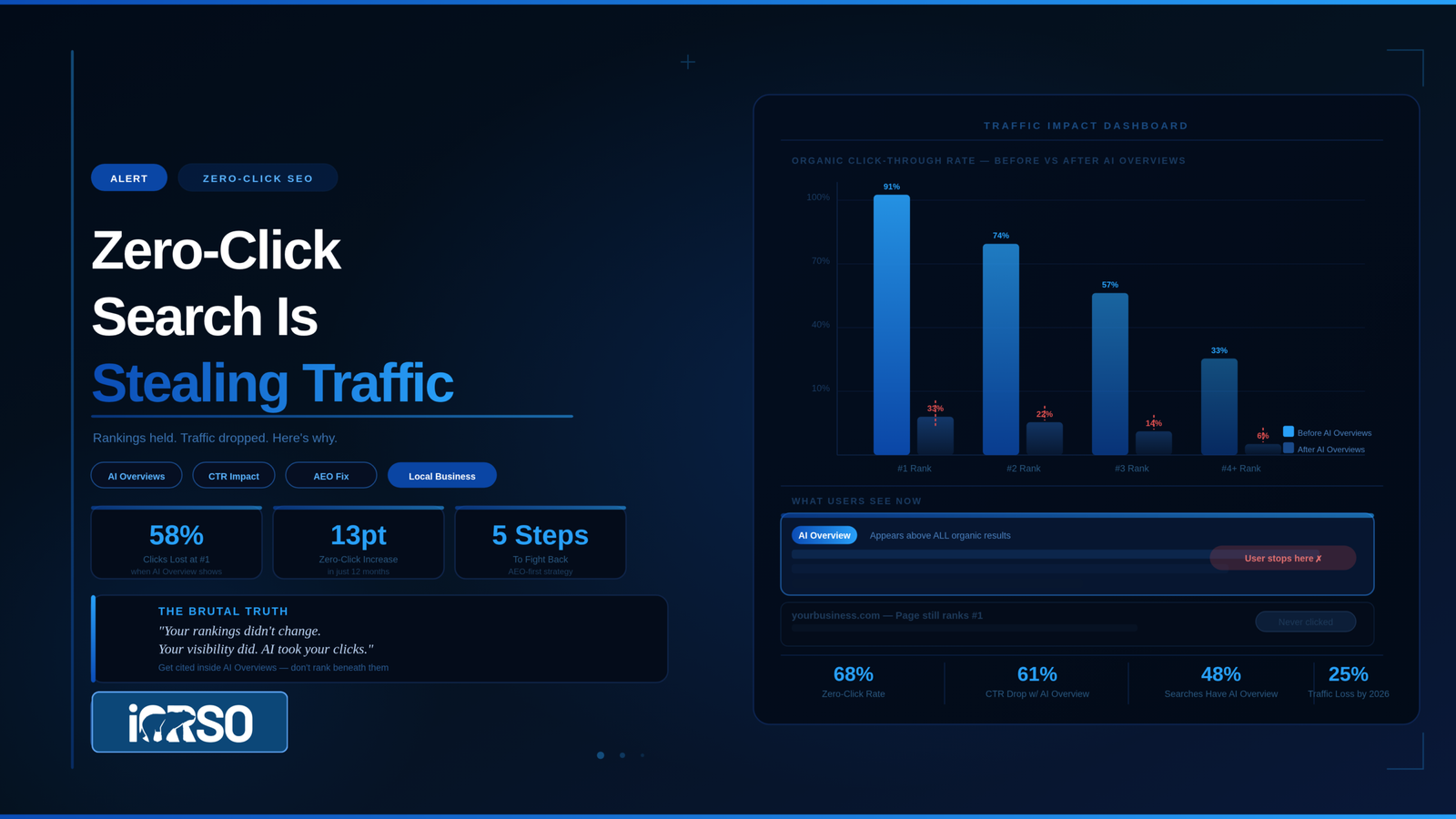
  • 60-68% of Google searches end without a click to any website (SparkToro/Datos/Similarweb, 2025-2026)
  • Zero-click rate jumped from 56% to 69% between May 2024 and May 2025, a 13-point increase that aligns with the AI Overview rollout (Similarweb)
  • AI Overviews now appear on 48% of all searches, a 58% year-over-year increase (BrightEdge, February 2026)
  • Organic CTR drops approximately 61% when an AI Overview appears on a query (Seer Interactive, September 2025)
  • Even #1 rankings lose 58% of their clicks when Google shows an AI Overview above them (Ahrefs, December 2025)
  • Gartner predicts a 25% drop in traditional search engine traffic by end of 2026

Why Your Traffic Dropped But Your Rankings Did Not Change

This is the most confusing part for business owners: you log into Google Search Console, see the same rankings you had six months ago, but your traffic is down 25-40%. The disconnect has a specific cause.
Google added AI Overviews above your organic listing. Your ranking position did not change, but a new section appeared above you that answers the user’s question directly. The user reads the AI-generated answer, gets what they need, and never scrolls down to your link. Your impressions may have increased (Google counts AI Overview appearances as impressions in Search Console), but your clicks dropped because fewer users need to click through.
This pattern hits service businesses and B2B companies hardest. BrightEdge data shows that industries with heavy informational content, including healthcare, education, professional services, and consulting, see the highest rates of AI Overview disruption. E-commerce holds up better because users still need to click through to buy products.

How Zero-Click Search Affects Atlanta Small Businesses

For a local business in Cumming, Marietta, or Sandy Springs, zero-click search creates three specific problems.
Problem 1: The phone stops ringing, but nothing looks broken. Your Google rankings are stable. Your website is still live. Your Google Business Profile is active. But calls from organic search are down 20-35% because the AI Overview is answering queries that used to send people to your site. A plumber in Kennesaw who ranked #2 for “emergency plumber Kennesaw” used to get 15-20 calls per month from that ranking. Now Google’s AI Overview answers the query with a summary that includes competitor names, pricing ranges, and response times pulled from multiple sources. The plumber’s ranking is the same, but monthly calls from organic search dropped to 8-10.
Problem 2: Your competitors are named in AI answers, and you are not. When Google’s AI Overview answers “best personal injury lawyer in Alpharetta,” it names 2-3 firms. If your firm is not one of them, you are invisible to every user who reads that overview and makes a call. There is no second chance. The user does not scroll down to the organic results. They trust the AI’s recommendation.
Problem 3: You are measuring the wrong things. If your only KPIs are website traffic and keyword rankings, you are missing the full picture. A business can have declining traffic and growing visibility if it is being cited in AI Overviews. Conversely, a business can have stable traffic but be losing market share because competitors are capturing AI citations it never sees.

What You Can Do About Zero-Click Search

Zero-click search is not a problem you can fix by doing more of the same SEO. It requires a fundamental shift in strategy. The goal is no longer just to rank on Google. It is to be the source that AI cites when it generates its answer. The businesses winning in this environment are not fighting AI Overviews. They are getting cited inside them. That means restructuring content for AI extraction, building the entity signals AI systems use to decide who to recommend, and measuring visibility in places Google Analytics was never designed to track. The five steps below are listed in priority order based on impact and speed to results.

1. Get Cited in AI Overviews Instead of Fighting Them

Businesses that appear inside AI Overviews gain 35% more clicks than those that do not, according to Deep Marketing’s analysis. Being cited in the AI-generated answer is now more valuable than holding position #1 in the organic results below it. This requires Answer Engine Optimization (AEO), which structures your content and online presence so AI systems can find, trust, and quote your business. The good news: 60% of AI citations come from pages that do not rank in Google’s top 20, so you do not need to outrank every competitor to win AI visibility.

2. Structure Your Content for AI Extraction

AI Overviews pull from web pages that provide clear, direct answers. Front-load your key information in the first 2-3 sentences of every page (44% of ChatGPT citations come from the first 30% of content). Add FAQ sections to service pages (FAQ content nearly doubles AI citation rates). Use specific numbers, prices, and timeframes instead of vague claims. Keep sections between headings at 120-180 words for optimal extraction.

3. Build Your Entity Signals

AI systems recommend businesses they recognize as established, trustworthy entities. This recognition comes from a complete Google Business Profile, consistent directory listings, active reviews (50+ Google reviews minimum), mentions on platforms like Reddit and Yelp, and press or “best of” list inclusions. Businesses with active review platform profiles are 3x more likely to be cited by AI systems.

4. Add Schema Markup to Your Website

Schema markup tells AI exactly what your business does, where you operate, what you charge, and what customers say about you. Sites with proper structured data are 2.5x more likely to appear in AI-generated answers. Focus on LocalBusiness, Service, FAQPage, and Article schema types for local service businesses. Google’s March 2026 core update increased the weight of schema as an entity verification signal for AI citations, making structured data more important now than at any point in the last decade.

5. Shift Your Metrics

Stop measuring only traffic and rankings. Add these AEO metrics to your reporting: citation count (how often AI names your business), share of voice (your business vs competitors in AI results), brand search volume (people searching your business name directly after hearing it from AI), and conversion rate from AI-referred traffic (which runs 5-13x higher than traditional organic traffic). Bain and Company recommends tracking brand search volume in Google Search Console as the strongest indicator. If branded searches are growing even as generic organic traffic declines, your visibility strategy is working.

Zero-Click Search Adaptation Quick Facts

  • Citation advantage: Brands cited in AI Overviews gain 35% more of the remaining clicks (Deep Marketing, 2026)
  • AI referral growth: Traffic from AI platforms increased 527% year over year (AllAboutAI, 2025)
  • Conversion advantage: AI search visitors convert 5-13x higher than traditional Google visitors (HubSpot CMO data, Q4 2025)
  • Speed advantage: AEO can produce results in days to weeks, vs 6-12 months for traditional SEO
  • Monitoring gap: 84% of businesses are not yet tracking their AI citation presence
  • First-mover window: The first businesses in a local market to optimize for AEO establish citation patterns that are difficult for competitors to displace

The Opportunity Inside the Problem

Zero-click search sounds like bad news, and for businesses that do nothing, it is. But the data also reveals a significant opportunity for businesses that adapt early.
AI search traffic converts at 5-13x the rate of traditional Google traffic, according to HubSpot’s internal data. Users who reach your business through an AI citation are more qualified because the AI already pre-screened your business as the best match for their specific query. Fewer visitors, but dramatically better visitors.
60% of AI citations come from pages that do not even rank in Google’s top 20 results. This means smaller businesses with strong entity signals and well-structured content can outperform larger competitors who rely on domain authority alone. AEO levels the playing field in ways that traditional SEO never did.
The window is open now. 84% of businesses are not monitoring their AI presence. Every month you wait is a month your competitors have to establish themselves as the AI-recommended option in your market. Once an AI system recognizes a business as the authoritative answer for a category, that citation pattern reinforces itself and becomes harder for latecomers to displace.

What Adaptation Looks Like: An Atlanta Example

A medical practice in Sandy Springs noticed a 32% drop in organic website leads between January and June 2025 despite stable Google rankings for their top 15 keywords. Their web designer confirmed no technical issues. Their ad spend had not changed. The cause was Google AI Overviews appearing on 9 of their 15 target queries, answering patient questions about symptoms, treatment timelines, and insurance coverage directly on the results page.
The fix took 8 weeks. The practice added FAQ sections to every service page with specific answers about costs, insurance acceptance, appointment wait times, and treatment durations. They deployed LocalBusiness, Service, and FAQPage schema across the site. They generated 35 new Google reviews in 60 days with a post-visit email sequence. By month three, the practice appeared in AI Overviews for 6 of those 9 queries. Organic leads recovered to 94% of the pre-drop baseline, and AI-referred traffic added a new channel that had not existed before.

Frequently Asked Questions

What is a zero-click search?

A zero-click search is a Google query where the user gets their answer directly on the search results page and leaves without clicking any website link. Google delivers these answers through AI Overviews, featured snippets, knowledge panels, and local map packs. Between 60% and 68% of all Google searches in 2026 end this way.

Why did my website traffic drop but my rankings stayed the same?

Google added AI Overviews above your organic listing. Your ranking did not change, but a new AI-generated section now appears above your link and answers the user’s question directly. Organic click-through rates drop approximately 61% when an AI Overview is present, even for pages holding position #1.

Are AI Overviews permanent or will Google roll them back?

AI Overviews are permanent and expanding. They now appear on 48% of all Google searches, up 58% year over year. Google has invested billions in AI infrastructure and is integrating AI Overviews deeper into its core search product. The trend will accelerate, not reverse.

How do I get my business cited inside an AI Overview?

Optimize for Answer Engine Optimization (AEO): build strong entity signals (complete Google Business Profile, 50+ Google reviews, consistent directory listings), add schema markup to your website, structure content with direct answers and FAQ sections, and use specific data points rather than vague claims. Businesses with review platform profiles are 3x more likely to be cited.

Which industries are hit hardest by zero-click search?

Services, consulting, healthcare, education, and B2B companies see the highest disruption from AI Overviews. These industries have heavy informational content that AI can summarize effectively. E-commerce holds up better because users still need to click through to purchase. Local service businesses in competitive markets like Atlanta are in the highest-impact zone.

Should I still invest in SEO if zero-click is rising?

Yes. SEO remains the foundation that feeds AI retrieval systems. Pages must be indexed, authoritative, and relevant before AI can cite them. AEO builds on top of SEO, not instead of it. The businesses winning in 2026 invest in both: SEO for traditional organic traffic and AEO for AI visibility and citations.

How do I measure success now that clicks are declining?

Add these metrics alongside traditional traffic tracking: citation count (how often AI names your business), share of voice in AI answers, brand search volume in Google Search Console (growing brand searches signal growing AI visibility), and conversion rate from AI-referred visitors. iORSO’s free AEO Mini-Scan establishes a baseline across all major AI platforms.

See Where Your Business Stands

Get your free AEO Mini-Scan from iORSO. We test your visibility across ChatGPT, Perplexity, and Google AI Overviews, and show you exactly which searches your business is invisible on. No pitch, just data. We respond within 24 hours.
For the full picture on how AI search works and what you can do about it, read our guide to what AEO is and why it matters. To understand the first 90 days of an AEO engagement, see what to expect in your first 90 days of SEO and AEO.

Share the Post:

Have Questions? Let’s Connect

We’ll get back to you within 24 hours. No obligation.