
Content Clusters SEO: Why Old Tactics Don’t Work Anymore
Gone are the days when publishing random blog posts stuffed with keywords could rank Your Website. In 2025, Google’s algorithms prioritize topic authority, meaning your site needs to demonstrate expertise, not just post content.
Enter content clusters, the modern SEO framework that helps small businesses rank higher, build credibility, and attract more qualified leads.
What Are Content Clusters?
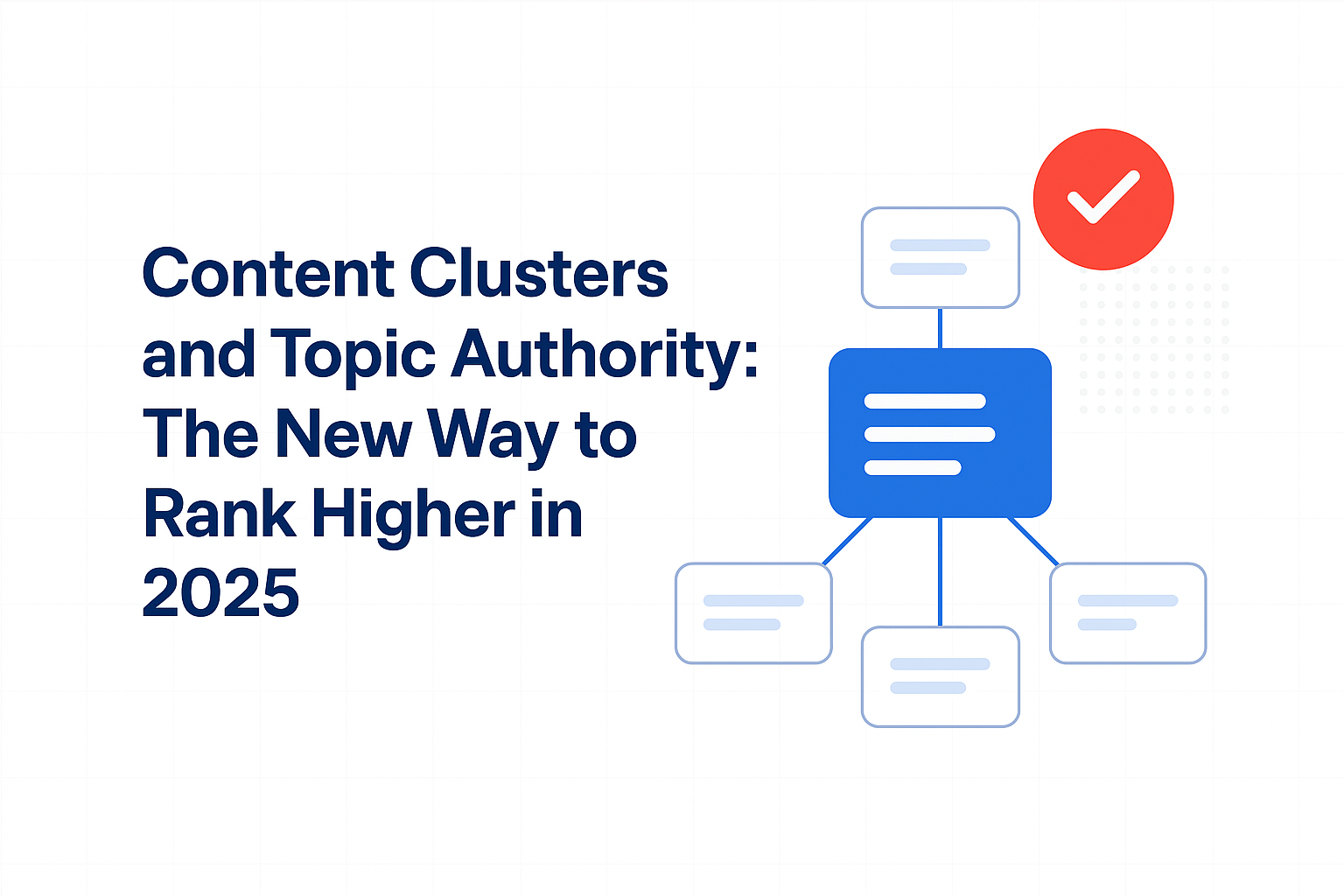
A content cluster is a group of related pages organized around one main “pillar page.”
- The pillar page covers a broad topic (e.g., “SEO for Small Businesses”).
- The cluster pages explore subtopics (e.g., “Local SEO,” “Technical SEO,” “Voice Search Optimization”).
- Internal links connect them all, helping search engines understand your site’s structure.
This architecture signals to Google that your website has depth, authority, and relevance, three critical ranking factors in 2025.
Why Topic Authority Matters in 2025
Search engines are smarter than ever. Instead of counting keywords, they now evaluate:
- How comprehensively you cover a topic.
- How related pages link together.
- Whether users stay and engage with your content.
By building content clusters, small businesses can outperform bigger competitors with stronger topical relevance, even with smaller budgets.
Learn how our SEO Services help SMBs build topic authority that drives sustainable rankings.
How to Build Effective Content Clusters
- Choose a Core Topic (Pillar)
Start with a pillar topic that aligns with your main service, for example:
- “Complete Guide to Local SEO for Small Businesses”
- “The Ultimate Small Business PPC Handbook”
This becomes your main hub page.
- Identify Subtopics (Cluster Content)
Use tools like Google’s “People Also Ask,” Ahrefs, or SEMrush to find related queries.
Example cluster for “Local SEO”:
- “Voice Search Optimization for Local Businesses”
- “How to Optimize Google Business Profile”
- “Local Link Building Strategies in 2025”
Each cluster links back to your main pillar.
- Interlink Everything
Internal linking is the glue that makes content clusters work. Every subtopic should link back to the pillar, and the pillar should link out to each cluster article.
This web of internal links helps Google map your site’s authority.
Our On-Page SEO Services ensure your interlinking and structure support stronger rankings.
- Update and Expand Regularly
Topic authority isn’t static, it’s earned over time.
Update your pillar content every few months, add new clusters, and optimize old posts to keep them relevant.
The Result: Higher Rankings and Stronger Trust
When Google sees a well-organized content ecosystem, it recognizes your site as a subject matter expert.
The payoff:
- More keyword rankings.
- Increased organic traffic.
- Better lead quality.
Small businesses in Atlanta and other local markets can especially benefit by building local topic clusters, blending SEO expertise with geographic relevance through our Atlanta digital marketing team.
How iORSO Builds Topic Authority for Clients
At iORSO, we structure SEO campaigns using content clusters that help small businesses own their niche online. Our process includes:
- Strategic keyword and content mapping.
- On-page optimization and interlinking.
- Continuous updates for evolving SEO algorithms.
With our SEO Services your website doesn’t just rank, it becomes the go-to authority in your industry.
Step-by-Step Implementation Guide
Before diving into advanced tactics, make sure your foundation is solid. Here is a practical roadmap for small businesses:
Month 1: Technical Foundation. Start with a comprehensive site audit. Check page load speed, mobile responsiveness, and crawl errors in Google Search Console. Fix broken links and ensure your XML sitemap is up to date. These technical basics account for roughly 30% of your ranking potential.
Month 2: Content Optimization. Review your top 20 pages by traffic. Update title tags, meta descriptions, and heading structures. Add internal links between related pages to strengthen topical authority. Every page should answer a specific question your target audience is asking.
Month 3: Local and Off-Page Signals. Claim and optimize your Google Business Profile. Ensure NAP consistency across all directories. Begin building relationships with local organizations and industry partners for natural backlink opportunities.
Common Mistakes to Avoid
Many small businesses sabotage their own efforts without realizing it. Here are the most frequent issues we see:
Ignoring search intent. Ranking for keywords that do not match what your audience actually needs wastes time and budget. Before targeting any keyword, search it yourself and analyze what Google currently ranks. Match your content format to what is already working.
Neglecting mobile experience. Over 60% of searches now happen on mobile devices. If your site is difficult to navigate on a phone, you are losing more than half your potential customers. Test every page on multiple screen sizes.
Expecting overnight results. Sustainable growth takes 3 to 6 months of consistent effort. Any provider promising page-one rankings in 30 days is either cutting corners or being dishonest about what is achievable.
From Random Blogs to SEO Powerhouses
In 2025, it’s not about how much you publish, it’s about how well your content connects.
By building content clusters, you Create a scalable SEO framework that tells Google, “We’re the expert here.”
Ready to become a topic authority? Request a free SEO audit with iORSO today and see how we can improve your rankings with a smart content strategy.
Learn more about internal linking seo. Learn more about SEO and AEO services.
Implementation Roadmap
Knowing what to do and actually doing it are two different challenges. Here is a practical timeline for putting these strategies into action:
Week 1: Audit your current situation. Before making changes, document where you stand today. Measure current metrics, identify gaps, and prioritize based on potential impact. This baseline ensures you can measure progress accurately.
Weeks 2-4: Quick wins first. Focus on changes that require minimal effort but deliver noticeable results. These early wins build momentum and justify further investment in the process.
Months 2-3: Systematic improvements. With quick wins secured, move to structural changes that require more time but deliver lasting benefits. Document processes as you go so they can be repeated or delegated.
Measuring What Matters
Many small businesses track vanity metrics that look impressive but do not connect to revenue. Focus instead on these actionable indicators:
Customer acquisition cost. How much are you spending to win each new customer? Track this across all channels to identify your most efficient growth levers.
Conversion rate by channel. Not all traffic is equal. Measure how effectively each channel converts visitors into leads or customers. A channel with lower traffic but higher conversion rates may deserve more investment.
Customer lifetime value. Understanding how much each customer is worth over their entire relationship with your business transforms how you think about acquisition spending. A $500 customer acquisition cost is expensive if average lifetime value is $600, but it is a bargain if lifetime value is $5,000.
Next Steps
The strategies outlined above work best when implemented consistently over time rather than as one-time projects. Start with the approach that addresses your most pressing business challenge, measure results for 30 days, then expand to additional tactics.
If you need guidance on where to begin or want a professional assessment of your current situation, schedule a free consultation with our team. We specialize in helping small businesses implement these strategies efficiently, without the trial-and-error that wastes time and budget.